TL;DR
If your electrician quotes an EV charger install without doing a written load calculation, picking up the meter base cover, and physically measuring the run distance, the quote is a guess. Here's the 4-step survey we've used on every install since 2019 — and the three failure modes it catches.
Over the last three years we've installed Level 2 chargers in 600+ homes across the Greater Montréal area — from 1920s Plateau triplexes to 2023 new builds in Kirkland. The single biggest reason we have zero callbacks for panel-side surprises isn't tools or training. It's that every survey follows the same 4 steps. No exceptions.
Step 1 · Read the panel
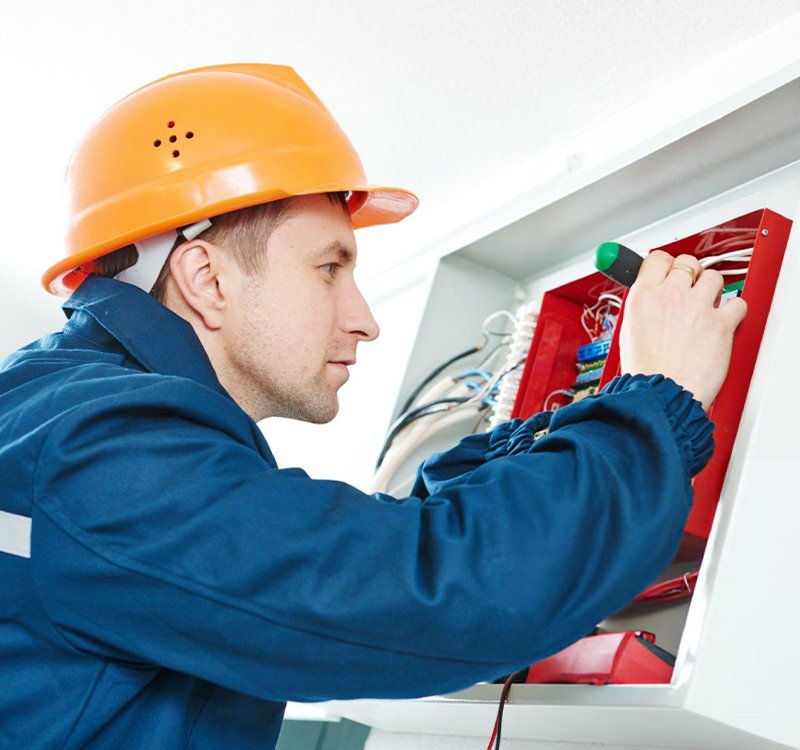
The first thing we do is pop the panel cover. Not the dead-front behind it — the cover. We're looking for three things:
- Service rating — what the panel is rated for (100A, 125A, 200A, 400A). This is stamped on the main breaker.
- Available spaces — physical slots left for a new double-pole breaker. A 200A panel might still be full.
- Brand and age — Federal Pacific, Zinsco and Sylvania-Challenger panels need to be replaced before we add anything. Insurance companies are starting to drop policies on these.
If any of these three flags come up, we tell the homeowner before we measure anything else. That's a different conversation, with a different number, and pretending otherwise is how surprises happen.
Step 2 · Run the load calc
This is the step that 80% of EV installers skip. A written load calculation, on paper, that adds up every continuous and non-continuous load on the panel: HVAC, water heater, range, dryer, existing receptacle circuits. Then we add the new charger at its full nameplate rating and check if we're still under the panel's 80% continuous limit.
A 100A panel can host a 40A continuous charger if the rest of the load adds up to less than 40A continuous. The number isn't “does it fit in a free slot.” The number is “will it trip the main on a January morning.”
About 20% of the homes we survey need a panel upgrade. Most of them have either an induction range plus a heat pump plus a dryer (homes built post-2018), or they're 60–80 year old service entrances that should've been upgraded a decade ago. Either way — knowing this before the truck arrives on install day is the entire point.
Step 3 · Measure the run
Conductor sizing is a function of amperage and distance. A 50A circuit at 25 feet is 8 AWG copper. The same 50A circuit at 80 feet is 6 AWG. The cost difference is significant — but more importantly, undersizing the conductor will work for years, then fail on the coldest day of the year when the wire's resistance climbs and the voltage drop becomes intolerable.
We measure with a laser distance meter, not by eyeballing it. Then we add 15% for actual conduit run vs. straight-line distance. If anyone tells you a number for an EV install without putting their own legs through the run, you're being quoted by an estimator, not an electrician.
Step 4 · Choose the hardware
By this point you should already know:
- What service amperage your panel can support.
- What continuous amperage your existing load can spare.
- What conductor you can run economically.
Now — and only now — do we talk about chargers. Most homes end up at 40A continuous (50A breaker, 8 AWG, FLO Home X5 or Tesla Wall Connector at 40A setting). Higher-output homes with the panel headroom go to 48A continuous (60A breaker, 6 AWG, Tesla or Wallbox at max). Lower-output situations — long runs, marginal panels — go to 32A continuous on 8 AWG.
The point isn't to sell you the biggest charger. It's to match the hardware to what your house can actually deliver, cleanly, for the next 15 years.
Mistakes we still see
From the install-day calls we've had to fix from other electricians' work:
- Sharing a circuit with a clothes dryer — the homeowner was told this was “efficient”. It's not legal, and it'll trip every time both run.
- NEMA 14-50 plug at 50A continuous — code limits plug-and-cord connections to 80% of the breaker, so 40A continuous on a 50A circuit. Hardwire if you want the full 48A.
- Aluminum conductor on AL-rated breakers, no antioxidant — works for a year, then thermal cycling loosens the connection and you've got a fire risk.
- No GFCI on outdoor or garage installs — required by 2023 code amendments. We still pull covers off month-old installs missing the GFCI breaker.
The checklist · save this
If you're hiring an electrician — anyone, including us — ask them to walk you through these before they quote:
If all six are yes, you're in good hands — ours or anyone else's. If two or more are no, get another quote.
Need this done properly?
We install Level 2 chargers across Greater Montréal. Free survey, written load calc, permits + rebate handled.